Amazon COSMO & Rufus AI Search 2026: The Ultimate Seller Optimization Playbook
Amazon e-commerce search has shifted from keyword matching to intent-driven artificial intelligence. Powered by COSMO’s 29-million edge knowledge graph and Rufus’s generative AI assistant, sellers must adapt to noun phrase optimization, semantic relations, and conversational recommendations to dominate search results in 2026.
1Core Definitions: What Are COSMO and Rufus?
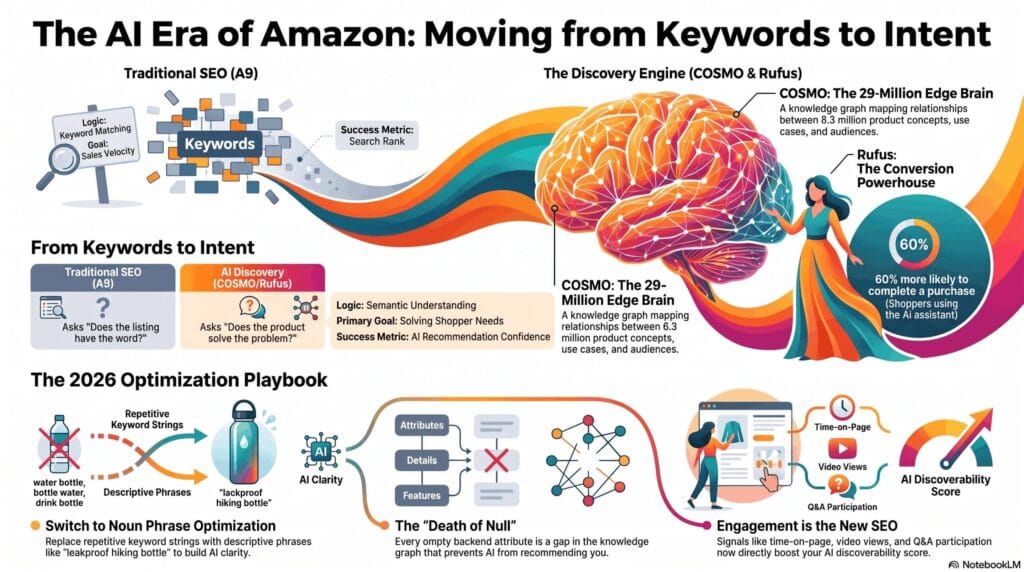
What is COSMO? COSMO (Common Sense Knowledge Generation and Serving System) is Amazon’s large-scale e-commerce knowledge graph. Built using Large Language Models (LLMs) and neuro-symbolic AI, COSMO contains 6.3 million nodes and 29 million edges across 18 product domains, mined from over 1.87 million search-buy pairs and 3.14 million co-buy pairs.
Plain-language explanation: If traditional search treated Amazon like a dictionary, COSMO treats it like a human brain. When a shopper searches for a “leakproof hiking water bottle,” COSMO understands the underlying customer intent—outdoor durability, insulation, drop resistance, and backpack fit—even if those exact words are missing from the search bar.
What is Rufus (Alexa for Shopping)? Rebranded as Alexa for Shopping in mid-2026, Rufus is Amazon’s generative AI conversational shopping assistant. Powered by models like Claude Sonnet and Amazon Nova via Amazon Bedrock, Rufus uses Retrieval-Augmented Generation (RAG) to answer buyer questions and recommend products directly in chat.
The Relationship: COSMO is the brain that maps product relationships, while Rufus is the voice that talks to the customer. Rufus queries the COSMO knowledge graph alongside product detail pages, customer reviews, and Q&A to deliver personalized recommendations.
For research documentation on knowledge graph architectures, visit the Wikipedia Knowledge Graph portal and Amazon’s published papers on arXiv.org.
A9 vs. COSMO & Rufus: The 3-Layer Search Architecture
| Layer Component | Legacy A9 Algorithm | COSMO & Rufus (2026 Engine) |
|---|---|---|
| Primary Question Asked | “Does this listing contain the exact keyword typed?” | “Does this product solve the specific problem described?” |
| Discovery Logic | Lexical text string matching | Semantic intent mapping & neural embeddings |
| Ranking Signals | Sales velocity & exact match density | Attribute completeness, sentiment & conversation confidence |
| Role in 2026 | Initial candidate retrieval pool | Intent filtering & top-tier conversational recommendation |
2Key Statistics & Industry Performance Benchmarks
Data from late 2025 and 2026 reveals the massive commercial scale of AI-assisted shopping on Amazon:
300+ Million Active Users
Rufus reached over 300 million active shoppers, with monthly active interactions growing by 210% year-over-year.
$12 Billion Incremental Revenue
Amazon attributed nearly $12B in annualized sales directly to AI assistance, projecting $56B in GMV by 2028.
60% Higher Purchase Likelihood
Shoppers who engage with Rufus during a shopping session are 60% more likely to complete a purchase.
12% to 18% Conversion Lift
Sellers who optimize listings for COSMO relations see up to 70% session increases and 20-62% unit sales uplifts.
Top products recommended by Rufus average over 15,000 reviews and a 4.6-star rating. High social proof and solid conversion velocity remain essential prerequisites before AI agents will surface your ASIN as a top pick.
3Practical Seller Implications: What Works vs. What Fails
Optimizing for COSMO requires fundamental updates to your copy, backend data, and media assets:
The “Death of Null”: Complete Every Backend Attribute
Every empty attribute field in Seller Central (material, target audience, occasion, dimensions, compatible models) represents a black hole in COSMO’s knowledge graph. If an attribute is left blank, Rufus cannot verify if your product fits a specific customer query.
Organize catalog SKUs cleanly using our free Amazon SKU Generator and verify brand compliance with our Amazon Brand Name Checker.
Switch to Noun Phrase Optimization
Stop repeating raw keyword strings like “water bottle, bottle water, drink bottle”. Instead, use rich descriptive noun phrases such as “insulated leakproof stainless steel hiking water bottle”. Noun phrases give AI models immediate contextual clarity.
Optimize Dense A+ Content Text
Visual-only image banners in A+ Content are invisible to Rufus indexing. A+ Content must feature dense, natural-language text (minimum 500+ words) with comparison tables and factual details. Explore our specialized Amazon A+ Content Design Services to upgrade your brand modules.
| Outdated A9 Tactic | 2026 COSMO & Rufus Replacement Tactic |
|---|---|
| Keyword Stuffing | Noun Phrase Optimization (Descriptive contextual phrases) |
| Blank Backend Attributes | “Death of Null” (100% attribute completion) |
| Image-Only Banners in A+ | Dense Text Modules & Comparison Tables (500+ words) |
| Generic Bullet Points | Problem/Solution Modular Framing |
4The 5-Question Live Audit Framework
To reverse-engineer how Amazon’s AI understands your product, perform this 20-minute DIY audit using Rufus on the Amazon Mobile App:
- Ask: “What is this product for?” Check if Rufus correctly identifies your primary use cases and features.
- Ask: “Who is this product best for?” Verify if Rufus targets your intended customer demographics.
- Ask: “What are the pros and cons of this product?” Review if negative sentiment in customer reviews is harming AI confidence.
- Ask: “How does this compare to [Competitor ASIN]?” Evaluate whether Rufus highlights your key differentiators.
- Ask: “Why should a customer buy this product?” Identify gaps where Rufus gives vague answers, signaling missing listing data.
Action Step: Wherever Rufus gives an uncertain or incorrect answer, rewrite your bullet points, Q&A section, or backend attributes to supply the exact missing facts.
5PPC Strategy & Industry Myth-Busting
Combining AI optimization with structured advertising is key to maintaining store growth:
The Danger of Day-Parting Ads
Turning off Amazon PPC ads overnight to save budget (“day-parting”) disrupts algorithm learning cycles, spikes CPCs by 15% to 30%, and damages overall organic sales momentum. Maintain steady ad velocity through data-driven Amazon PPC Management.
Myth-Busting: The “A10 Algorithm”
The term “A10 Algorithm” is a community-created rumor with no official standing inside Amazon engineering. Amazon transitioned directly from lexical A9 candidate retrieval to neuro-symbolic COSMO knowledge graphs and generative Rufus AI layers.
For full done-for-you store growth, keyword harvesting, and daily operations, explore our full-suite Amazon Account Management Services or schedule a 1:1 Strategy Consultation.
6Frequently Asked Questions
A9 is a lexical search engine matching exact keyword strings. COSMO is a 29-million edge knowledge graph that analyzes customer intent, use cases, and co-purchase relations.
“Death of Null” means leaving zero backend attribute fields empty in Seller Central. Every empty attribute creates a knowledge gap preventing Rufus from recommending your product.
Rufus uses Retrieval-Augmented Generation (RAG) to scan customer reviews and Q&A sections, verifying whether listing claims match actual buyer experiences.